


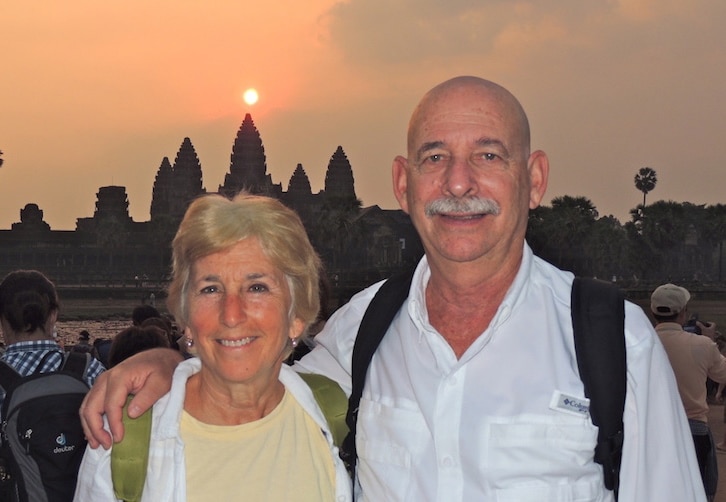
Life was starting to feel almost routine for us, though my husband and I were now navigating a new world – Gabarone, Botswana, ten miles north of the South African border.
As a volunteer business consultant at the University of Botswana, I was quickly meeting people and feeling my impact. I remember thinking, “Every conversation counts now.”
My husband, Dr. Michael Wall, was realizing much the same thing in his own new volunteer role. A retired pediatric lung specialist from Oregon Health and Science University, he now supervised four different rotating teams of medical residents at the University of Botswana Medical School. Each afternoon, he delivered lectures on pulmonary disorders, including chronic lung disease in HIV-infected children.
“Trying to make a small difference…not knowing if we’ll make any difference. But that’s what we came to do,” I emailed home to friends and family.
The fears I had did not come true. Michael and I did not catch any mosquito-born disease, nor were we laid low by heat stroke in the sweltering afternoons and evenings. And my worst fear – that I would be useless – looked ridiculous in hindsight.
In fact, my skills at process improvement, team building, and change management, honed through years of domestic and international work experience for G.E. and Hewlett Packard, were just right in helping the university staff.
As things went well for us during our four weeks in Botswana, we were more than hopeful about the next leg of the journey – a month in Siem Reap, Cambodia. There, the need for us was, if anything, even more stark.
“The chaos each morning (at the Angkor Hospital for Children) is stunning,” I wrote home. “They serve 180,000 patients each year; that’s almost 500 patients daily flowing through the outpatient department.”
After the genocide by the Khmer Rouge, only 40 doctors remained across the country from the 4000 trained. Even today, 35 years later, the hospital staff is hungry for specialized knowledge. Michael and I threw ourselves in to support the work of the hospital. I believe we each left our mark.
When we returned home in March, 2014, we felt satisfied by what we’d left behind, and also with what we took away, including memories: the chanting of Buddhist monks, the darkness around the temple filling with the light of hundreds of candles to celebrate the Buddha’s enlightenment, the children’s puppet parade that wound through the town and filled the streets with color. And the memory of so much kindness.
I love the experiences and love that we can be role models to others. My 42-year-old daughter says, “When I grow up, I want to become like you.”
It’s not retirement. It’s about the next set of challenges that one takes on. It’s the move away from structured work to purpose work, the redefining of one’s self and contributions. I love that notion: that aging isn’t about slowing down or stopping living in the world, but fully living in the world in a different way.